A French home rated DPE F or G costs more to heat, sells for less, and since 1 January 2025 a G-rated dwelling may no longer be let on a new lease. Secrets.RealEstate, which scores any French address from public building data, reads the DPE as the most price-relevant line in a listing — check it before you commit, not after.
What does a DPE rating actually decide?
The diagnostic de performance énergétique grades a home from A to G on two axes at once, energy use and greenhouse-gas emissions, and the worse of the two sets the letter you see. It is valid for ten years and it has to appear in every sale and rental listing, which makes it the one piece of building physics you are handed for free before a viewing.
Three consequences follow from the letter:
- The running cost. Heating is the bill you pay every month for as long as you own the home, and the gap between a C and an F is not a rounding error.
- The legal right to let it. Under the loi Climat et Résilience a G-rated dwelling has been excluded from new leases since 1 January 2025. F follows on 1 January 2028, E on 1 January 2034.
- The price. A poor label is a renovation bill with a date attached, and a buyer who has read the schedule negotiates with that date in hand.
How many French homes are rated F or G?
Of the 3,729,800 French residential buildings with a recorded DPE in the July 2025 BDNB release, 16.8 % carry an F or a G — 10.2 % F and 6.6 % G. Widen the band by one letter and 39.9 % of that stock is at E or worse, which is the share facing the 2034 cut-off.
The number matters twice. For a buyer it says the badly rated home you are looking at is not an outlier to be avoided on sight; it is one in six of the market, and it is priced accordingly or it should be. For an owner it says the renovation queue between now and 2034 is long, and the tradespeople in it are the same ones you will be calling.
Why the construction year predicts the label
France's first thermal regulation took effect in 1974. Among French buildings with a known construction year, 52.8 % were built before 1975 — no insulation standard applied to any of them, and the wall assembly, not the boiler, decides most of what the DPE measures.
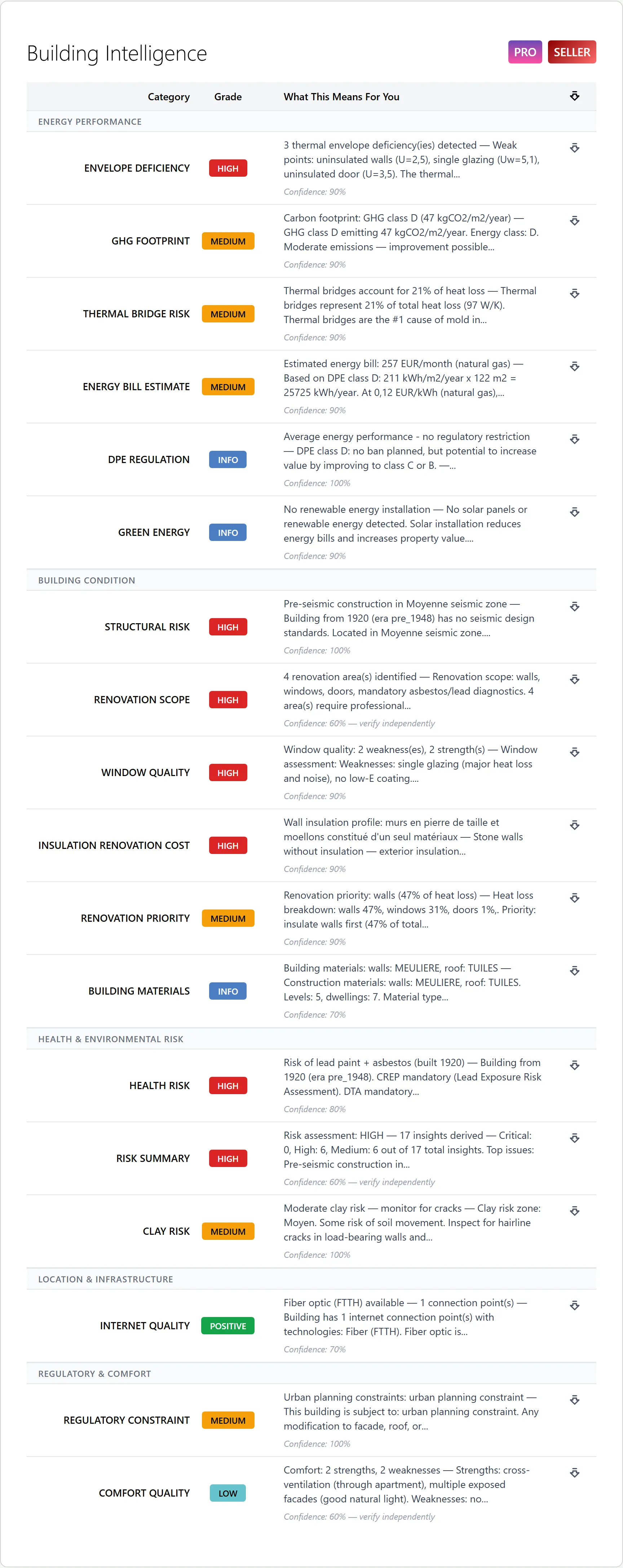
That is the practical reason to read the building rather than the letter. A 1962 block with a new heat pump and no wall insulation and a 1962 block after a full envelope retrofit can end up one letter apart, and only one of them has a cheap route to a better rating. The Building Intelligence section of a property report puts the construction year, the wall and roof material, the heating system and the recorded DPE on one screen for exactly this reason: see what it covers.
What is a DPE letter worth in price?
More on a house than on a flat, and the gap is measurable. The hedonic model behind the Secrets.RealEstate Property Price Calculator is fitted on a 2026 snapshot of roughly 26,000 French asking listings, with the location effect removed and the energy label, the construction era, the floor and the condition fitted jointly so none of them absorbs another's effect. On that fit, an A-rated house carries about 22 % more per square metre than an F-rated one, and an A-rated flat about 14 % more than a G-rated one.
Two honest caveats travel with those figures. They are measured on asking prices rather than recorded sales, so they describe what sellers ask and buyers accept as a starting point. And the bottom of the house table is flatter than the story suggests: F sits at 0.916 and G at 0.933, close enough that the two worst classes are effectively one class in the market's eyes. The money is not in the difference between bad and terrible. It is in the step from a D or an E up to a B.
For flats the spread is narrower — the location effect dominates everything else in dense cities — but it is not zero, and it is on top of a heating bill you will pay whether or not you noticed the letter.
Which French homes can no longer be rented out?
Since 1 January 2025 a dwelling rated G under the French DPE can no longer be handed over on a new lease, because the energy criterion is part of the legal definition of decent housing. F-rated homes follow on 1 January 2028 and E-rated homes on 1 January 2034. The scale of that is measurable: Secrets.RealEstate puts 16.8 % of French residential buildings with a recorded DPE at F or G in the July 2025 BDNB release, and 39.9 % at E or worse. The rule bites on new leases and renewals rather than on ownership, so a landlord with a sitting tenant is not evicted by the calendar — but the day that lease ends, a G-rated flat is off the rental market until it is renovated. For a buyer planning to let, the label is therefore not a running-cost question. It is a question of whether the asset can legally do the job at all.
What to check before you make an offer
- The date of the DPE. Anything issued before July 2021 used the old method and is not comparable with a current label.
- Both axes, not just the letter. A home can be dragged to F by its emissions while its energy consumption sits at E — gas heating does that, and the fix is different.
- The construction year and what has been done since. A pre-1975 building with no recorded renovation is where the letter and the real bill diverge most.
- The heating system and its age. A twenty-year-old boiler is a cost that arrives on its own schedule, whatever the label says.
- The estimated annual cost printed on the DPE. It is a modelled range, not your bill, but it is the range the next buyer will also read.

Where these numbers come from
The DPE shares are computed from the Base de Données Nationale des Bâtiments, July 2025 release, over the 3,729,800 residential buildings that carry a recorded DPE — buildings, not dwellings. The construction-year share covers the buildings for which a year is recorded. The price multipliers come from one joint regression on a 2026 snapshot of about 26,000 asking listings, location-demeaned, and are asking-price effects rather than sold-price effects. The regulatory dates are those of the loi Climat et Résilience as it applies in mainland France. When the BDNB is republished these shares move, so treat them as a July 2025 reading rather than a constant.
Frequently asked questions
Does an F label mean I cannot rent the home out?
Not yet. F-rated dwellings may still be let on a new lease until 1 January 2028. G-rated ones cannot, as of 1 January 2025.
Can a DPE be improved without a full renovation?
Sometimes. Insulating the roof and replacing an old boiler are the two moves that most often shift a single letter. Crossing two letters usually means the walls, and that is a different budget.
Is the DPE reliable enough to negotiate on?
It is a modelled figure, not a meter reading, and two diagnosticians can land one letter apart. What it does reliably is set the legal status and the next buyer's expectation, and both of those are negotiable facts.
How do I see this for a specific address?
Run the address through the property report and read the Building Intelligence and energy sections together: https://secrets.realestate/property-price-calculator